GST ITC Reconciliation: Recoverable vs Gone for Good
GST ITC reconciliation for CAs: which GSTR-2B mismatches are recoverable, which to chase, and which are permanently lost before the Section 16(4) deadline.
Legal references verified against the CGST Act, 2017 and CGST Rules (cbic-gst.gov.in) and the GST portal IMS advisory (gst.gov.in). Figures and rules current for FY 2025-26.
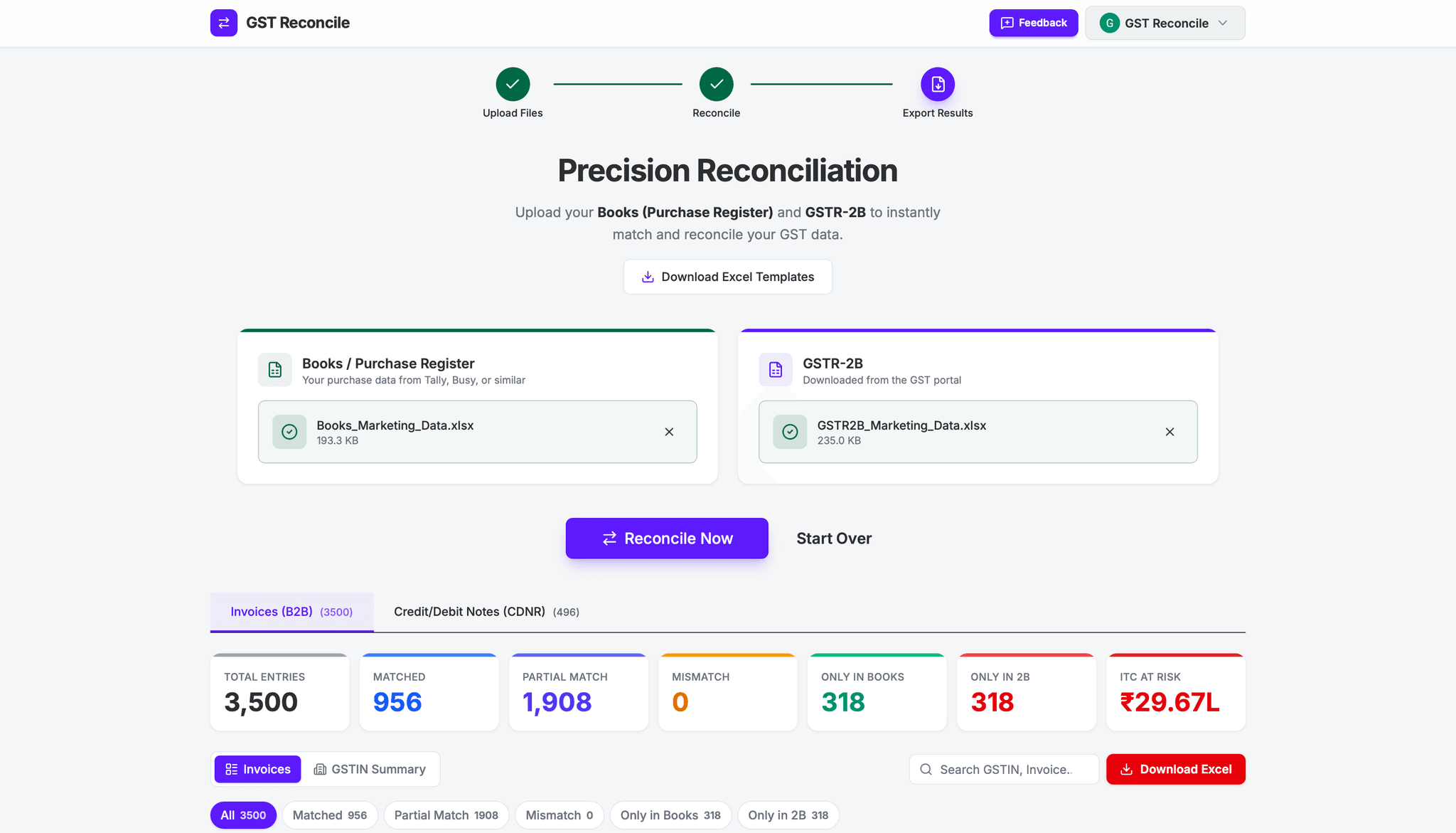
You've run the reconciliation. Two hundred lines come back as mismatches, and a number at the bottom says ₹4.2 lakh of ITC is "at risk." Now the actual work starts — because that ₹4.2 lakh is not one problem. Some of it you'll claim today, some you'll claw back by chasing a vendor, and some of it is already gone and no follow-up will bring it back.
This is the part generic GST reconciliation guides skip. They tell you to download GSTR-2B and match it against your purchase register. They don't tell you which mismatches are worth your Monday morning and which are a write-off. This article is the classification framework: for every mismatch type, whether the credit is recoverable now, recoverable later, or permanently lost — and the one decision to make for each.
If you haven't yet put a rupee figure on the exposure, do that first — our guide on calculating ITC at risk covers the arithmetic. This article is what you do after you have the number.

The four eligibility conditions every claim has to clear
Before classifying mismatches, fix the rule the whole exercise turns on. ITC is claimable only when all four conditions of Section 16(2), CGST Act are satisfied:
- 16(2)(aa) — the invoice appears in your GSTR-2B (your supplier filed GSTR-1).
- 16(2)(b) — you've actually received the goods or services.
- 16(2)(c) — the supplier has paid the tax to the government.
- 16(2)(d) — you've filed your own GSTR-3B.
Plus a fifth, sitting in the proviso and Rule 37: you must pay the supplier within 180 days, or reverse the credit until you do.
Every mismatch below is really a question of which condition is failing — and whether that failure is yours to fix, the vendor's to fix, or no one's. That's what decides recoverable versus gone.
The five mismatch buckets — and the verdict on each
A reconciliation that ends at "matched / unmatched" is useless here. You need the reason for each mismatch, because the reason is the verdict. This is the whole argument for a rules-based engine that classifies — not a VLOOKUP that just flags.
Here's the decision framework. Every line in your mismatch report falls into one of five buckets.
| # | Mismatch | Which condition fails | Verdict | Your move |
|---|---|---|---|---|
| 1 | In books, not in 2B | 16(2)(aa) — supplier hasn't filed GSTR-1 | Recoverable later | Chase the vendor before your 16(4) deadline |
| 2 | In 2B, not in books | None — you missed recording it (or wrong GSTIN) | Recoverable now | Record & claim, or reject if tagged wrongly |
| 3 | In both, values differ | Potential over-claim | Recoverable now | Fix the entry, claim the correct figure |
| 4 | In both, only invoice no. differs | None — false mismatch | Never at risk | Fix the match, not the claim |
| 5 | In 2B, but unpaid / 180-day / 17(5) / past 16(4) | 16(2)(c)/(d), Rule 37/37A, 17(5), 16(4) | Write-off | Defer, reverse, or write off — see below |
Bucket 1 — In books, not in 2B: recoverable, but on a clock
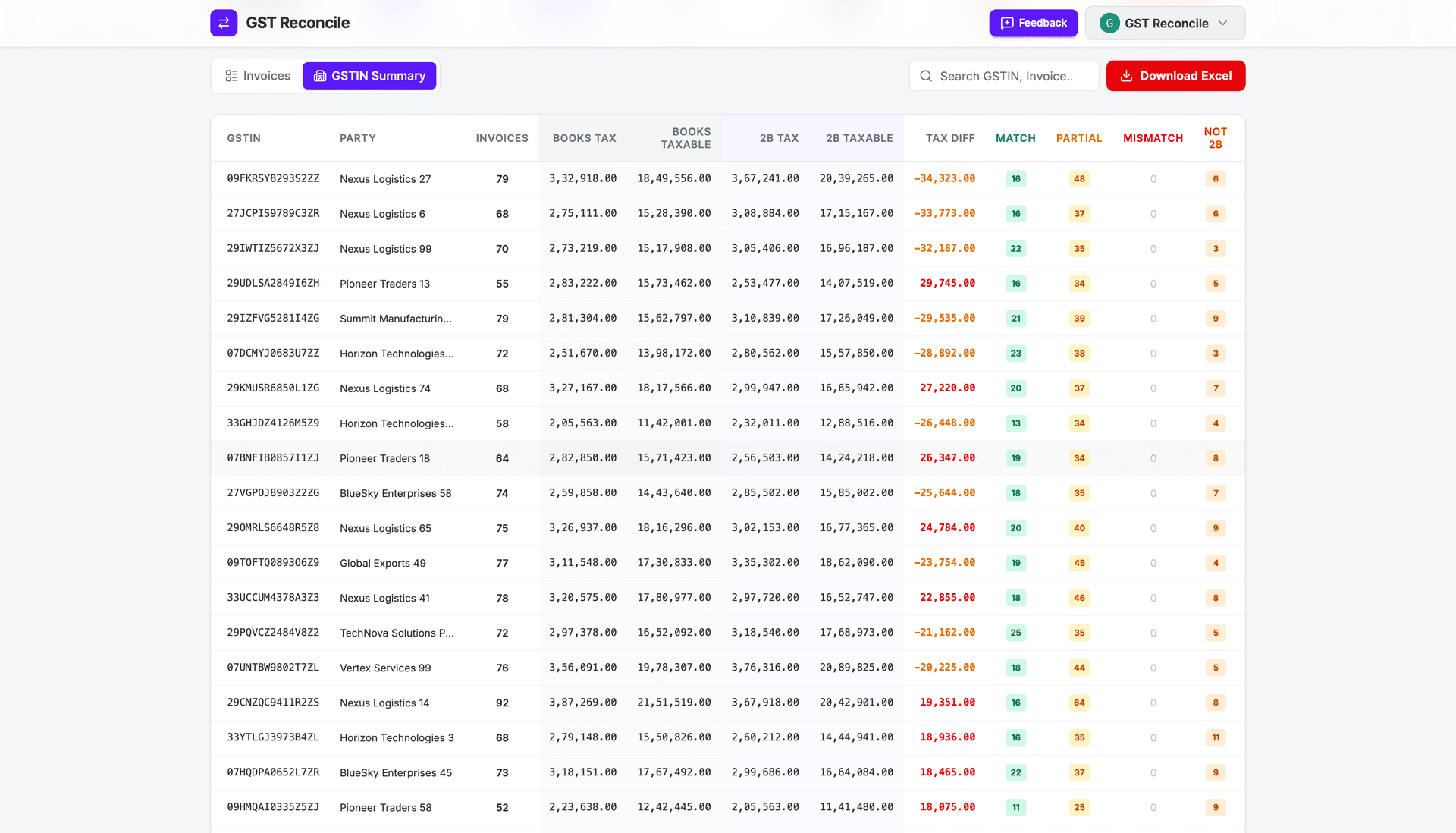
This is your real exposure. The invoice is in your purchase register, the goods arrived, but it isn't in GSTR-2B because the supplier hasn't filed GSTR-1. Under 16(2)(aa) you cannot claim it yet — and you can't legally claim it until it appears.
The verdict is recoverable later, conditionally. It comes back if the supplier files before your Section 16(4) cut-off (more on that date below). After that, it's gone. This is the bucket where chasing actually pays — our vendor-not-filed-GSTR-1 playbook has the follow-up email template and the escalation order. Sort this bucket by rupee value and start at the top; don't spend a follow-up email on a ₹180 credit.
Bucket 2 — In 2B, not in books: usually free money
The supplier reported an invoice you haven't recorded. Two cases. Either you genuinely missed booking a purchase — record it and claim, it's clean ITC you were about to leave on the table. Or the supplier tagged the wrong GSTIN and this isn't your invoice at all — in which case don't touch it, and if you're on the Invoice Management System (IMS), reject it so it doesn't flow into your 2B. (IMS went live on the GST portal on 14 October 2024 and lets you accept, reject, or keep an invoice pending before it lands in your GSTR-2B — see the GST portal IMS FAQ.)
Bucket 3 — Values differ: claim the right number, not the bigger one
Invoice matches on GSTIN and number, but the taxable value or tax amount differs between books and 2B. Almost always a data-entry slip or a ₹1 rounding difference. Recoverable now: claim the eligible amount that's actually reflected in 2B, and correct your book entry so it doesn't resurface next month. The trap is claiming your books figure when it's higher than 2B — that's an over-claim waiting for a notice.
Bucket 4 — Only the invoice number differs: the credit was never at risk
This is the bucket that inflates everyone's "ITC at risk" number for no reason. The credit is fine. The tool was wrong.
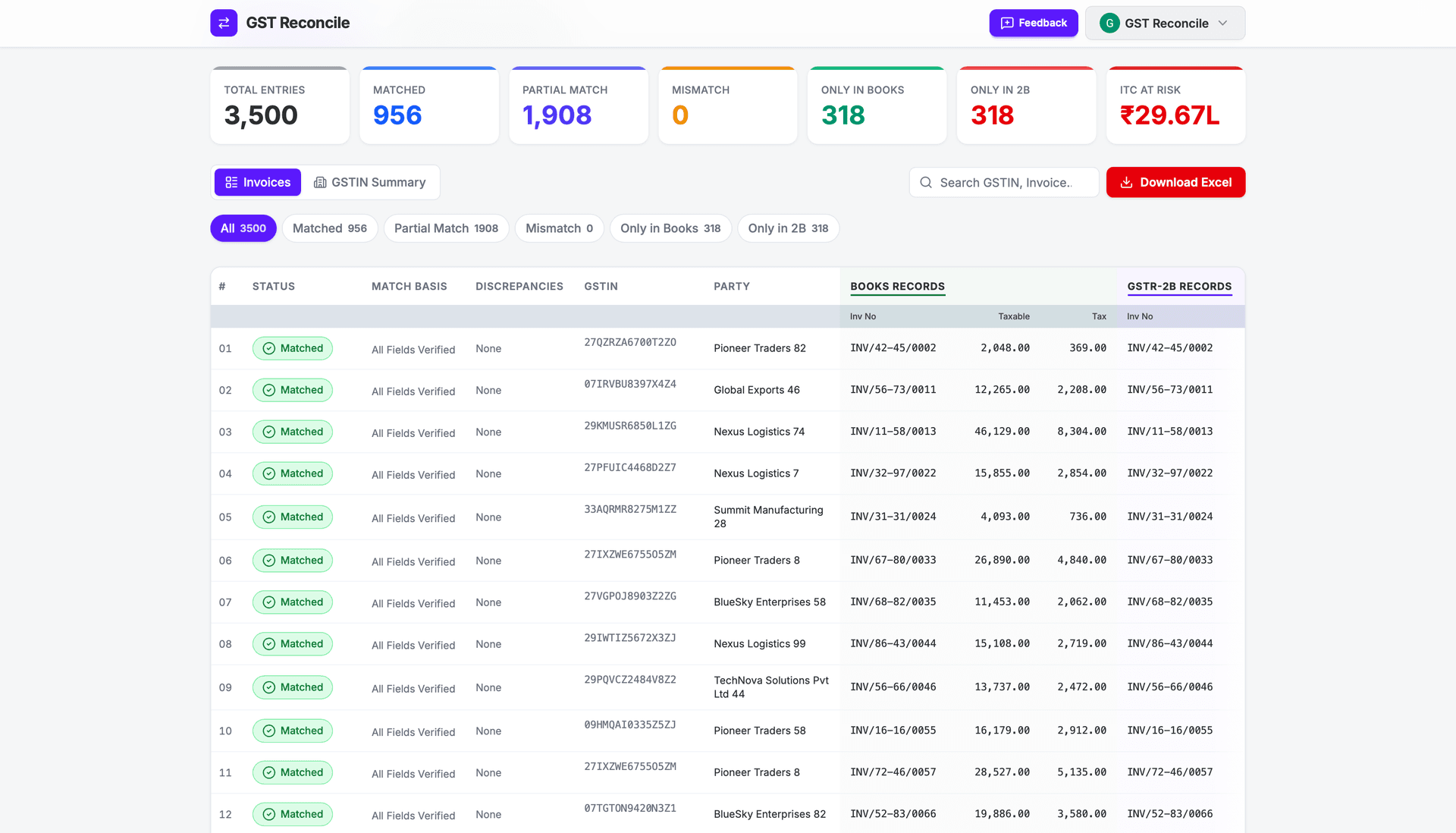
INV/202526/0042 in your books, INV/2526/42 in 2B. Same supplier, same value, same tax — and an exact-match tool screams "mismatch" and dumps it into your at-risk pile. It was never at risk. The FY prefix (202526 → 2526), a leading-zero drop, an O-for-0 typo, a date string baked into the number — these are normalisation problems, not ITC problems.
This is where the matching engine earns its keep. Our 21-rule classification engine runs the invoice number through normalisation passes — typo map, FY-prefix stripping, date-format handling, non-alphanumeric removal — before it calls anything a mismatch. The deterministic part matters: same inputs, same verdict, every run, because a rule-based engine isn't guessing. The result is that Bucket 4 mostly disappears, and the ₹ figure that's left is the exposure that's actually real. Nothing to recover here — you just stop counting credits that were never lost.
Bucket 5 — The conditional and the dead
This bucket holds four sub-cases. The first three are recoverable with conditions; the last two are write-offs.
- Supplier filed GSTR-1 but not GSTR-3B (hasn't paid tax). Fails 16(2)(c). Under Rule 37A, if the supplier still hasn't filed the relevant GSTR-3B by 30 September of the following year, you must reverse the ITC by 30 November of that year — or pay interest at 24% under Section 50. It's re-claimable when the supplier eventually files and pays. Recoverable, with a reversal in between.
- Payment to supplier not made within 180 days. Rule 37 — reverse now, re-claim in the month you pay. Recoverable, self-inflicted.
- Blocked credit under Section 17(5). Motor vehicles, personal consumption, works contract for immovable property, and the rest of the blocked list. This is permanently ineligible regardless of any match — it's not a reconciliation problem and should never have been in the at-risk pile. Write off; never claim.
- Past the Section 16(4) deadline. Covered next — permanently lost.
The deadline that turns "recoverable" into "gone": Section 16(4)
ITC for any invoice or debit note of a financial year can't be claimed after the earlier of 30 November following that FY or the date you file the GSTR-9 annual return for that year (Section 16(4), CGST Act, as amended by the Finance Act, 2022).
For FY 2025-26 invoices, that means the GSTR-3B you file for October 2026 (due 20 November 2026) is your last practical window, with the hard wall at 30 November 2026. Miss it and the credit is permanently lost — it can't be carried forward or claimed later.
One trap worth flagging to clients: filing GSTR-9 early pulls the deadline forward. File your FY 2025-26 annual return on 15 October 2026 and that becomes your ITC cut-off, not 30 November. Confirm every Bucket 1 credit is either claimed or written off before you file the annual return.
(The limited retrospective relief under Sections 16(5) and 16(6), inserted by the Finance (No. 2) Act, 2024, only helps for FY 2017-18 to 2020-21 and for registration cancellation/revocation cases — it does nothing for a current-year credit you let lapse.)
A worked month: where the ₹4.2 lakh actually goes
Take the opening number. After classifying, a typical month looks nothing like the headline:
| Bucket | Share of ₹4.2L | What happens to it |
|---|---|---|
| 4 — invoice-number false mismatches | ₹2.10L | Cleared by normalisation. Never at risk. |
| 2 — in 2B, not booked | ₹0.55L | Recorded and claimed this month. Found money. |
| 3 — value differences | ₹0.30L | Corrected, claimed at the right figure. |
| 1 — supplier hasn't filed GSTR-1 | ₹0.95L | Chase list, sorted by ₹. Recoverable till 30 Nov 2026. |
| 5 — 17(5) blocked / time-barred | ₹0.30L | Write-off. Was never claimable. |
The genuinely at-risk number was never ₹4.2 lakh — it's the ₹0.95 lakh in Bucket 1, and even that is recoverable if you act before the deadline. Half the original figure was Bucket 4 noise. This is the difference between a reconciliation that creates panic and one that creates a to-do list.
Read it per supplier, not per invoice
Two hundred mismatched lines isn't an action plan. The GSTIN Summary view collapses them to the only question that matters for Bucket 1: which supplier is sitting on how much of my ITC, in rupees, sorted largest first. One vendor holding ₹70,000 across nine unfiled invoices is a phone call; forty vendors holding ₹400 each are not worth the same week. Reconciliation at the invoice level tells you what's wrong. The per-supplier rupee view tells you what to do — and in what order.
A note on credit and debit notes (CDNR): reconcile these separately from B2B invoices. A supplier's credit note reduces your ITC; mixing it into the B2B pass produces wrong classifications and a wrong at-risk figure. Handle the two streams in separate passes — then your Totals & Checks view actually ties out for month-end sign-off.
What this means for your monthly workflow
ITC reconciliation isn't a matching exercise you pass or fail. It's a sorting exercise: every mismatch gets one of five verdicts, and four of the five have a clear next action. Do it monthly, not at year-end, because Bucket 1 runs on the Section 16(4) clock and a supplier who's slow in April is a write-off by December.
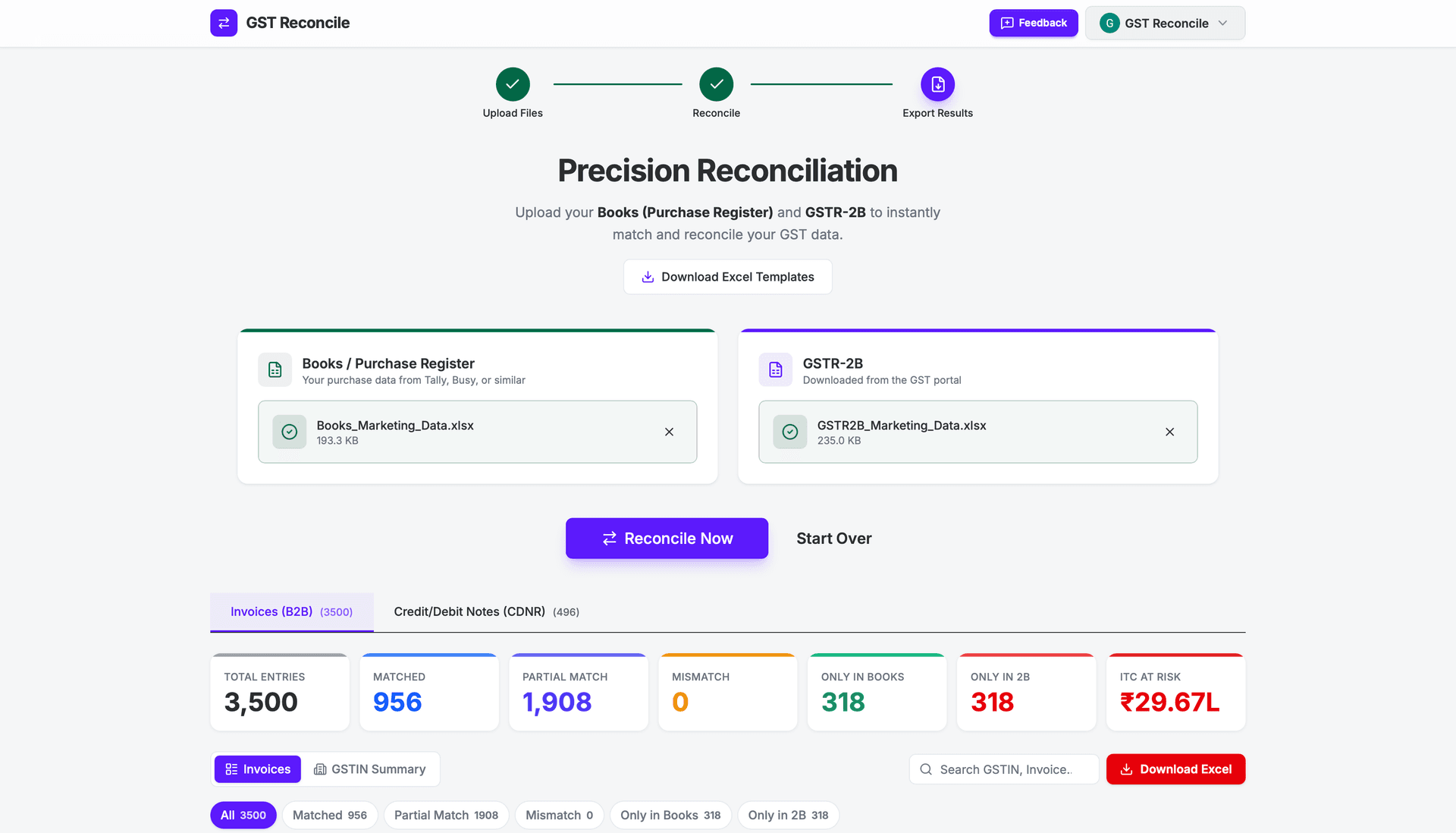
Download the Books template, drop in your unmodified GSTR-2B portal file, and let the engine classify — then work the buckets in order: clear Bucket 4, bank Buckets 2 and 3, chase Bucket 1, write off Bucket 5. The whole point of a proper GSTR-2B reconciliation is to end the month knowing your real exposure to the rupee — not a scary number that's mostly typos.
Frequently Asked Questions
How do I reconcile ITC under GST?
Match every purchase invoice in your books against the GSTR-2B for the same period, then classify each line: matched, value mismatch, missing in 2B, or missing in books. ITC is claimable only on invoices that appear in your GSTR-2B (Section 16(2)(aa), CGST Act). The reconciliation isn't the matching — it's deciding what to do with each mismatch.
Can I claim ITC if the invoice is not in my GSTR-2B?
No. Section 16(2)(aa) makes appearance in GSTR-2B a condition for claiming ITC. If your supplier hasn't filed GSTR-1, the invoice won't show in 2B and the credit isn't claimable yet — but it's recoverable if they file before your Section 16(4) deadline.
What is the last date to claim ITC for FY 2025-26?
30 November 2026, or the date you file your GSTR-9 annual return for FY 2025-26, whichever is earlier (Section 16(4), CGST Act). For monthly filers, the GSTR-3B filed for October 2026 is the last practical return. After that, the credit is permanently lost.
Do I lose ITC if my supplier files GSTR-1 but not GSTR-3B?
Not immediately. Under Rule 37A, if the supplier hasn't filed the GSTR-3B for that invoice by 30 September of the following year, you must reverse the ITC by 30 November of that year, or pay interest at 24% under Section 50. You can re-claim it later once the supplier files and pays.
Does a mismatch in the invoice number mean my ITC is at risk?
Usually not. Most invoice-number mismatches are false — an FY prefix (202526 vs 2526), a typo (O vs 0), or a date string buried in the number. The credit was never at risk; an exact-match tool just flagged it wrong. A rules-based engine that normalises the number before comparing clears these automatically.
Reconcile Your GSTR-2B Free
No VLOOKUP gymnastics. No data stored on external servers.
Works with Tally, Busy & ClearTax. Up to 99.99% accurate.
No signup required · ₹450+ Cr ITC Saved · 12.5M+ Invoices Matched